
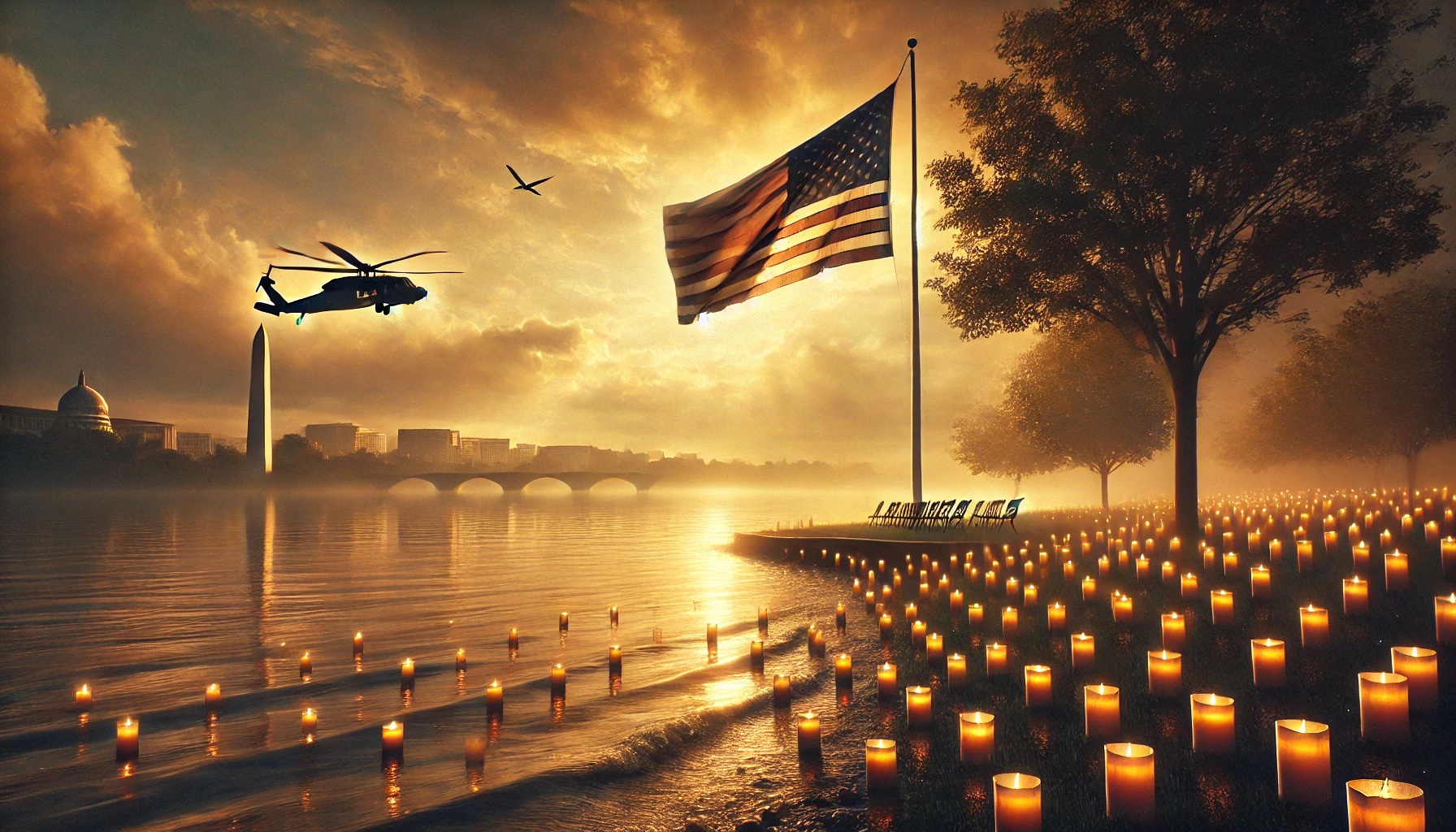
Tragedy has a way of stopping time. One moment, the world hums along as usual. The next, we are forced to confront the unthinkable.
The collision of American Airlines Flight 5342 and a US Army Black Hawk helicopter over the Potomac River claimed 67 lives; 67 stories that ended too soon. It is the deadliest aviation disaster in the U.S. since 2001, and yet, as with any mass tragedy, we often struggle to comprehend the sheer scale of loss. Numbers are impersonal. A headline fades. But then, we hear a name, a detail, a story that makes it real.
For me, that moment came when I learned that three young attorneys were on board: Sarah Best, Elizabeth Keys, and Kiah Duggins. I didn’t know them, but I could see my own life reflected in theirs. I imagined their ambition, their drive, their desire to make a difference. And suddenly, the tragedy wasn’t distant. It was near.
That’s the paradox of loss: we mourn most what we see ourselves in.
But this tragedy wasn’t just about young attorneys. It was about a mother and her 11-year-old son. A fiancé who never made it home to his wedding. A group of figure skaters and their coaches. Soldiers who had committed their lives to service. A teacher who had dedicated her career to shaping young minds. A flight attendant who was finally living her dream.
In the diversity of these losses, we are all invited to find a wake-up call. Maybe it’s the young athlete who reminds you of your own child. Maybe it’s the teacher who echoes someone who shaped your life. Maybe it’s the soldier, the mother, the friend. Somewhere in this tragedy, we all find a reflection staring back at us.
And what does that reflection ask of us?
Seeing Clearly Too Late
I’ve written before about what I call the postmortem effect—how we often see people most clearly only after they’re gone. In life, we get distracted by titles, careers, and achievements. But when the final word is written, we do not mourn résumés. We do not grieve LinkedIn profiles. We mourn the person. Their laughter. Their presence. The way they made us feel seen, understood, valued.
It is only in loss that we truly see what mattered all along.
The objective world—the world of facts and statistics—tells us that 67 people died. It lists their names and their professions. It tells us what time the plane was supposed to land, what went wrong, who was at fault.
But the subjective world—the world of love, memory, and relationship—is what makes life life. The objective world can take someone away, but it cannot erase the imprint they leave behind.
Sarah and Elizabeth are remembered not for what they did, but for who they were. Ryan O’Hara, the soldier who left behind a wife and a 1-year-old son, will not be remembered for his military rank but for the way he loved his family. Julia and Sean Kay, the mother and son who perished together, will not be remembered as just passengers on a doomed flight, but as a mom and her little boy, inseparable in life and now in memory.
And so, we ask ourselves: What will remain when we are gone?
Living for What Lasts
Maybe the only way to process death is to live in response to it—to wake up to the truth that our lives are not defined by what we accomplish, but by who we are and how we love.
Ecclesiastes 3:11 says that God has set eternity in the human heart. We ache for permanence in a world that is passing away. And that longing—for life to mean something, for love to last beyond loss—is not an accident. It is a signpost.
In Saving the Subject, I write about the tension between the objective world—the world of facts, status, and records—and the subjective world—the world of presence, meaning, and relationship. The world we live in often demands that we chase the former. But in moments like these, we are reminded that it is the latter that truly matters.
Sarah, Elizabeth, Kiah, Ryan, Julia, Sean—each of the 67 had a life that meant something, a life that touched others in ways that will never be forgotten. Because in the end, we are not remembered for what we did, but for how we loved.
So may we love people for who they are while we still have the chance—to truly see them here, before they journey elsewhere. And may we live in such a way that, when our own story comes to an end, those who remain can say, they loved well.
Because in the end, that is what remains.
Leave a Reply