
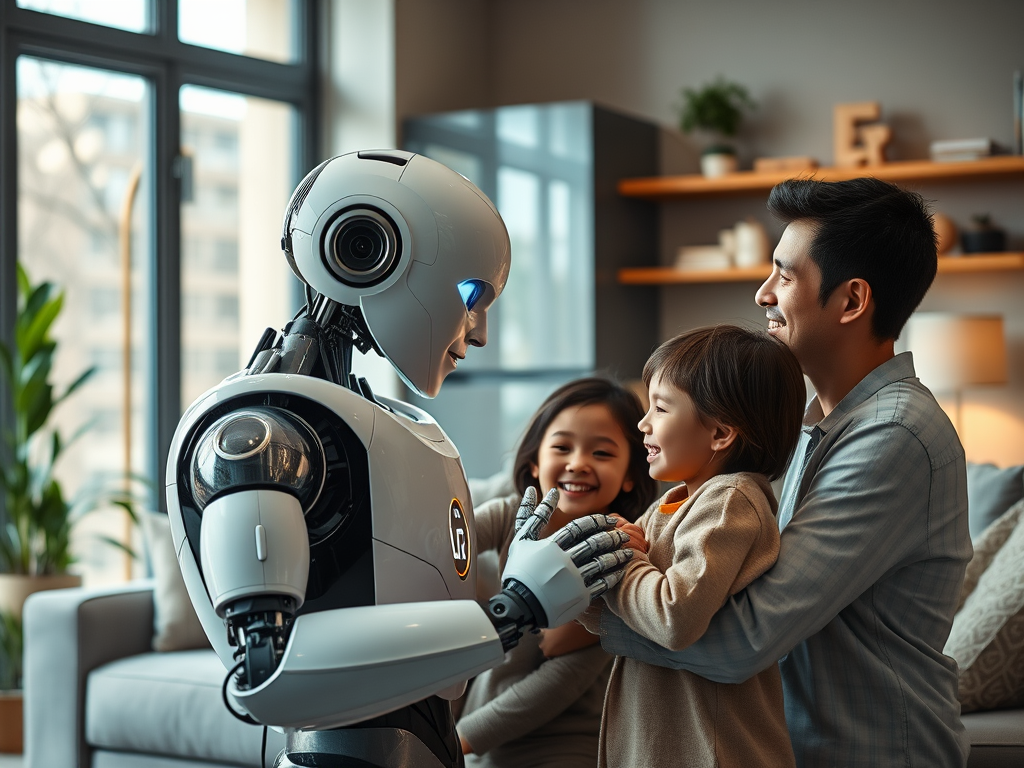
Elon Musk’s recent announcement about launching Tesla Optimus robots for both industrial and home use marks a significant shift in our integration with technology. Production to start in late 2025, these robots will perform tasks ranging from household chores to providing companionship for the elderly. Check out this video that details the plans, or this one to see the full scale of AI’s power and risks. This move isn’t just a technological leap; it’s a catalyst for urgent philosophical and ethical debates about the essence of being human in an increasingly automated world—a conversation that, surprisingly, few are having.
The human-like capabilities of AI are growing, and they promise real benefits: taking over hazardous tasks and freeing us for creative and interpersonal roles. While AI will inevitably replace certain jobs, it also opens doors to new opportunities. Yet, the true challenge isn’t just adapting to these shifts or learning new skills—though older generations may find this daunting. It’s about holding onto our humanity as machines begin to mirror our actions and interactions, blurring the lines between us and them.
As we near what I call “the global blink”—the moment when we collectively grasp how quickly AI has taken over our jobs, entertainment, military, economy, healthcare, and daily lives—we face an existential struggle. This mirrors the personal crisis I endured after my brain injury in 2015, but now it’s unfolding on a global scale. While many focus on AI safety, few are asking about the psychological and spiritual safety of living in an AI-driven age. This is a gap that demands our attention.

(Click here for more of the accident story w/pictures–warning graphic content).
There’s a war coming that no one is talking about: AI’s assault on personhood. It’s challenging how we see ourselves, how we value ourselves, and how we preserve our humanity. In my book, Saving the Subject: How I Found You When I Almost Lost Me, I draw from my coma-to-courtroom journey to reveal how our humanity transcends measurable traits like intelligence or achievements. This perspective becomes vital as AI forces us to rethink what it means to be truly human. For AI only terrifies those who do not see themselves as more than machines (p. 190).
When Objects Mimic Subjects
The subject-object framework I explore in the book offers a psychological life-preserver for this new age. Subjects—like you, me, anyone who suffers, learns, and transforms—experience life with a sacred depth. Objects, like rocks or basic machines, are passive, without awareness. But today, that distinction is fading. AI crafts poetry, mimics emotions, and “converses” with us, while algorithms curate our realities. Soon, with Tesla’s Optimus robots, this technology will have legs to walk right up to us.
With Tesla’s Optimus robots soon handling chores, childcare, and elderly people, we’ll be surrounded by intelligent objects that promise innovation—potentially transforming the world like nothing before. Yet there’s a profound challenge, and one of impersonality.
Imagine a robot reading to your child, its voice steady but its soul absent—will it truly connect? Or imagine a robotic preacher, expounding on the Bible better than Charles Spurgeon, the “prince of preachers,” or Timothy Keller, having read every sermon they’ve ever preached, coupled with every other sermon in known history. Will the message truly move any of the congregants?
Sure, there is no “soul” required for mopping a floor or taking out the trash, but there is a soul required for teaching a child, mentoring a young person, and maintaining emotional wellbeing. AI will continue to obscure the divide between processing and experiencing, because it is a system that cannot fathom or support what we really are and who can become. So, we must remember: AI will always remain an object in a world of subjects.

A Framework for the AI Age
Today’s discussions about AI are solely focused on what it can do. My focus is on what AI can never be: a “who.” Readers of Saving the Subject have noted how they were “wonderfully surprised“ that this book is not just about my story; it’s “much more,” as one newspaper put it. The book offers a lens for the new world ahead: the subject-object distinction.
This framework promotes fostering human relationships over automated interactions, such as prioritizing time with family, friends, and God, to counter AI’s potential to isolate and objectify, offering a relational lens based in genuine connection. Additionally, the book implicitly guides ethical AI use by urging society to resist objectification trends.
You’ll feel the existential crisis I’m referring to before you’re ready. It might be the unease of a conversation with an AI that sounds too perfect, or the moment a company swaps a real customer service rep for an automated “empathy” bot that greets you at the door. When that happens, my framework will be there, naming the longing for subjectivity that technology can never fulfill.
My primary concern is not for the loss of jobs or the terminator drones to come–although, as previously stated, those are worthwhile concerns. My concern is that we will lose ourselves in a world of artificial “selves.”

Writing Saving the Subject showed me someone I can always be, someone that no-one and no-thing could ever take from me. I call this the “subjective life”:
a life of invincibility, where one perceives in peace regardless of what is being perceived. It’s a life of victory, where one is not brought down by things because he’s already been brought down in being. It’s a life of generosity, where one gives without reservation because he sees how much he’s been given.” (p. 164).
Don’t take after me and require a crisis to know who you really are.

Leave a Reply