There are some moments in life you never—ever—expect to happen. This is one of those moments…
This keynote happened at the convergence of so many threads in my life: my traumatic brain injury, my journey through law school and fatherhood, my work as an attorney, and the deeper questions about identity that have haunted and shaped me ever since.
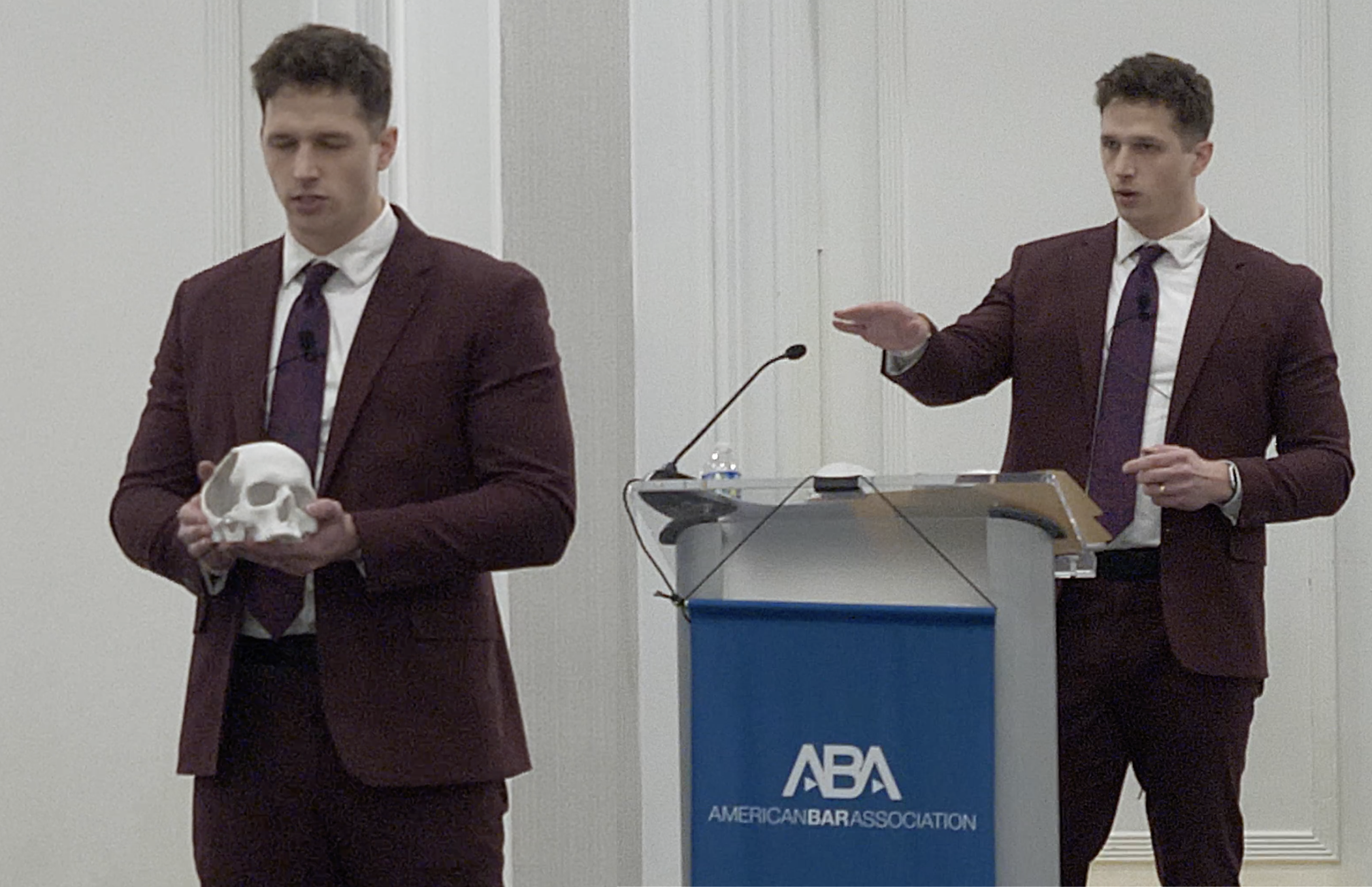
It was delivered on September 18, 2025, precisely ten years to the day of the accident that nearly ended my life. And somehow, by God’s grace, through his providential plan, on that sacred 10 year anniversary, I found myself standing before a room of lawyers, LAP directors, and mental health professionals at the American Bar Association’s National CoLAP Conference, giving voice to something I’ve carried for a long time.
What follows is the full transcript of that message—“More Than What We Do: Lawyer Identity in an Age of Automation”—along with the video recording, including the PowerPoint slides and the live recitation of my Performative Utterance Project (PUP). If you’ve wrestled with questions of worth, presence, performance, or who you are beyond what you do—this talk is for you.
Thank you for receiving it.
MORE THAN WHAT WE DO
LAWYER IDENTITY IN AN AGE OF AUTOMATION
CAMERON MICHAEL FATHAUER
September 18, 2025
American Bar Association
CoLAP National Conference
Portsmouth, Virginia
Good evening, it’s with much grace that I can stand up here today. Thank you, Amy, Tashiana, and Yvette –– you’ve entrusted me with a sacred moment.
My name is Cameron Fathauer. I’m a husband, father, author, and attorney from Southern Indiana. I’m not here for you to admire me; I came to think with you. I’m not here to give another inspirational talk. I’m here to lay myself down at the feet of a profession starving for soul and identity.
I’ll open with my own journey—the night my world shattered and the roller coaster that followed —not as a spectacle, but as a mirror to the fractures in the legal profession ––– fractures that are magnified by AI and automation.
I’ll close by offering something new—something practical. A pro-active resource designed to reach lawyers early—before burnout, before breakdown, before they forget who they are. And I’ll share this resource in a manner you’ll never forget.
But first, I need to thank my good friend Will Rieske, who helped me prepare this keynote. He wanted me to tell you: “That this is a big moment for Cameron––and that some may even call it his “Fat- hour.”
But since it’s been reduced to 40 minutes, I guess it’s my “Skinny Hour.”
The best way to begin––what is going to be most helpful––is to start with where it all went wrong.
On this very evening exactly ten years ago, September 18, 2015 – my entire life changed in an instant.
I was riding a skateboard outside my parents’ driveway, showing my nine-year-old neighbor Hannah some tricks. There were no sidewalks – all we had was the road to play on. The speed limit was set at 20 miles per hour, but the driver of the speeding Lexus didn’t seem to mind the sign.
My head shattered the windshield, my body dented the rooftop, and I landed unconscious 20 feet away in a neighbor’s yard. The elderly driver and his wife were covered in bloody glass shards.
Hannah, not seeing the crash but having heard it, ran fast into her grandma’s house screaming, “Cameron’s been shot, Cameron’s been shot!”
About a week later, my father found one my sneakers dangling 60 feet up in a tree.
I was airlifted to a trauma hospital in Indianapolis, where I remained in a noninduced coma for nearly three weeks.
Physicians diagnosed me with a severe diffuse axonal injury to the brain stem—one of the most devastating forms of traumatic brain injury or TBI for short. Over 90% of patients never regain consciousness, and those who do often remain profoundly impaired.
My family was warned that if I did wake up from the coma, I wouldn’t be myself anymore, likely having a child’s mind for the rest of my life….
In some ways, those doctors were right….
Because when my eyes finally opened, I found myself in an unfamiliar world:
I couldn’t walk, talk, or even remember the name of my fiancée, Chelsea, who I asked to marry me just a month earlier.
Like an etch-e-sketch that has been shaken clean, I had to relearn just about everything.
Despite the odds, I made what has been deemed a “miraculous” recovery, being discharged from acute rehab in Indianapolis six months ahead of schedule.
But the “miracle” of my TBI recovery was limited to what I call the “objective,” surface level world. Because I looked okay on the outside, everyone assumed I was all good on the inside. But the way I look and perform in the objective world tells you little about how I’m doing at the subjective, inner level …… I’m sure some of you can relate to that.
After my second brain surgery, the doctors gave me a 3D replica of my skull, much like this one.
I felt so different after my brain injury––the headaches, the depression, the sensitivity to everything – light, noise, medications, emotions––everything.
My faith told me I was more than my brain. But the brain injury whispered something else. As I wrote in my journal years ago:
This is your forever life, Cameron. The way you feel
today––depressed, dragged, undone––is the way
you will always feel. Those strange looks? They’ll
keep coming. Those close friends? They’ll keep running.
Those goals of yours? They’ll need rewriting.
These questions, these existential burdens, weighed heavily on me; and I couldn’t carry them alone. No human can, nor should any try.
The accident happened during my senior year of high school, and I had made two important relational decisions:
First, at the start of the year, I gave up my childhood dream of playing professional basketball, leaving the varsity team, and committing myself to pastoral ministry. I made this decision to pursue a deeper relationship with the Lord.
I cannot overstate how big of a deal this was for me because basketball felt like my identity growing up in Columbus, Indiana. For me to quit basketball felt a lot like quitting myself. But I was trying to live out the calling of self-denial and went all in for my pursuit of a deeper relationship with God.
The other big relational decision I made before the accident was asking my girlfriend, Chelsea, to marry me. On August 2, 2015, a 17-year-old Cameron Fathauer proposed to a 19-year-old Chelsea Franklin, and she said yes; but about a month later – as you know – her “yes” was put to the test ….
Despite every rational reason not to, Chelsea stood by my side throughout my entire recovery,
She lived out the marriage vows – “in sickness and in health” – before it even started. Her commitment to me as a person, regardless of my abilities, is a true example of love made beautiful.
No one was sure if I would ever wake up from the coma, or if I did wake up what I’d be like. Chelsea’s parents even said they’d understand if she chose to walk away, given my prognosis.
Her response? “I’d push him in a wheelchair for the rest of my life if I have to.”
My clients sometimes raise their eyebrows when they hear I proposed at 17. I get it—it sounds young. But for me, marriage was never just a contract; it was, and still is, a commitment between subjects, not objects—a union of whos, not whats. The vows are present-tense, personal commitments: ‘I do’ – not “I did” or “I will do” like other legal contracts. This is why I call marriage the most personal contract available.
These convictions come from my faith and belief that God doesn’t relate to his people as objects measured by their successes or failures, but as persons known and loved by faith in the life, death, and resurrection of Jesus Christ. This gospel-level love is personal, relational, and unshakable—and the scriptures say marriage was purposed to set the example.
Despite significant resistance, Chelsea and I married the day we had planned before the accident: March 26, 2016.
I’ve said it many times before, but “Chelsea you make me believe in God more.”
The most important truth I’ve learned over the last decade of my TBI recovery is that life is relational, not individual, and that life is personal only because it’s communal.
Put simply: no one can be themselves by themselves. This maxim anchors tonight’s talk and my
life’s work thus far.
For no one heals alone, no one rises alone, and no one overcomes alone.
Relationships are not accessories to our existence — they are the very ground of it.
And yet the legal profession so often celebrates this myth of the self-made man, the sovereign individual, the isolated hero. But I know firsthand how misleading that vision is, how lonely it is, and how frankly uninspiring it is.
The truth, and nothing but the truth, is that we are fragile beings that find ourselves in a world where everything can change in an instant, where what we have can be taken away at any moment, where what we do can be done better by someone or something else like AI.
But there is one thing that cannot be taken away in this life, this one ground we can always stand firm on: Who we are, and whose we are.
Given my prior commitment to ministry, Chelsea and I moved to Louisville, Kentucky, where I pursued an education at the Southern Baptist Theological Seminary.
She encouraged me to get a lawyer for my brain injury case, and this is how we found a well-respected trial lawyer in New Albany, Indiana, named Matthew Schad.
Meeting Matt was one of those divine appointments. He took an immediate interest and liking to us, taking us out for dinner following our consultation.
As they have done for decades now, Matt and the team at Schad Law provided me with exceptional representation and my case settled for policy limits within months.
Some have asked me how much money I got from the settlement, and the answer is not nearly enough to cover the $2 million in medical bills.
But this provides an opportunity to explain how I won the lottery in a different way: not in what I gained, but in who it brought me to:
(1) closer to my wife Chelsea, who has loved me through my recovery;
(2) to Matt Schad, who has loved me like a son; and
(3) now tonight, exactly 10 years after said accident happened, it has brought me to you all–– to
this moment where I’m calling the legal profession to take up relational arms and show the world that we are not defined by we do, win, or lose, but by the relationships we honor and the presence we provide when it matters most.
I was inspired to go to law school after meeting Matt. I wanted to help other injured people like myself, especially brain injury victims.
But that wasn’t the only reason I wanted to go to law school. The doctors kept telling me that due to the nature of your brain injury, Cameron, the hardest things for you will be higher level thinking, executive function, just using your brain, so I thought to myself, man, if I could do the LSAT I could do anything else. I spent about six months studying for it while taking full time classes at the seminary, and, by the grace of God and the support of Chelsea, I did get into a great law school: Indiana University Maurer School of Law in Bloomington, Indiana.
But my time in law school was less about learning law and more about staying alive….
The first thing that almost took me out during law school was internal. I struggled with severe depression and suicidal ideation after the accident. And it got worse during law school. “Can I get an ‘amen’?”
But this wasn’t your typical law school stress—it was a darkness that followed me constantly. It wasn’t there when I was around other people; but when class ended and we went our separate ways, I was approached by a dark spirit that tempted me to take my own life. I never wanted to harm anyone else, just myself.
But I found resolve in the power of language, often writing down my thoughts and feelings –taking pen to my pain.
For example, there was that dark winter night in November of 2018. I was a few weeks into my 1L year and couldn’t sleep. I knew of a nearby fire pit and went there to start a fire. I had a pen and my Civil Procedure spiral notebook with me. I often wrote my thoughts on whatever paper medium was readily available.
Here’s what I wrote at that lonely campfire:
Tonight is a beautiful night, but my heart is not so right.
I go from loving my wife, wishing I could give her the universe,
to hating my own life because of inner issues I cannot converse.
There is a darkness inside of me.
It’s the kind of darkness that only knows darkness.
Call it a blinding darkness.
I am describing the other me. The me
I hate to see but must see every day.
When I am overtaken by the
other me, I incur dementia, drop my morals, lose
my values and forget my family and friends.
My desires of suicide are only in pursuit of
disbarring myself from this wretched roommate:
No medication will do the trick.
No amount of therapy or conditioning
will outwork the other me . . .
Another word for this type of darkness would be appropriate.
The closest I can think of is the German Anfechtungen —
a word that lacks a clear definition because
it is meant to describe the undefinable depression.
And that is why the other me penned these
words at 12:09 a.m. this very night.
He wants the world to know his darkness.
Before the accident, I never considered killing myself, or ever once found myself depressed.
They actually called me the “eternal optimist” back then.
I loved elementary school; I loved middle school; and I loved high school––at least until was cut short. Yes, that’s a Hannah Montana t-shirt I’m wearing.
The second thing that almost took me out during law school was external.
Now what I’m about to share gets mixed reactions. Some say – “wow, you are so blessed” – others “How in the world?” and then a few have said, “That’s my worst my nightmare.”
At the end of my 1L year, just before my ConLaw exam with one of my favorite professors, Steve Sanders, my wife gave birth to our daughter Scarlett Jane, who is now 6 years old and constantly impressing us.
Being a parent in law school is no joke, and props to those of you doing it today.
But then came my 2L year when we found out my wife was pregnant again, and pregnant during COVID 19.
Nevertheless, on July 31, 2020, Chelsea gave birth to my other daughter, Charlee . . . .
She also gave birth to my son, Albert, on the same day –
Oh, and another one of my daughters, Frankii.
Yes, triplets– following an emergency c-section! And she carried them to almost 36 weeks!
In case the numbers came at you too fast like they did for me:
I fathered four children in law school within 14 months – all with the same woman – and still managed to graduate on time with my peers!
I went on to pass the bar and become a licensed personal injury attorney in Indiana and Kentucky.
What’s more: I get to practice law with the exact same attorney who worked my TBI case 9 years ago, Matthew Schad.
Matt has been an incredible mentor for me, a father-like figure.
Chelsea has been with me from Coma to Courtroom.
And those four little faces I’m blessed to call my children, remind me daily that presence outweighs performance, even if they frequently drive me and Chelsea a bit crazy!
Think for a moment: Who’s your Matt or Chelsea—who’s the one holding you up when life breaks apart? Is an old friend or mentor coming to mind? Who do you confide in or open up to – anyone other than yourself?
People need people, and no one can be themselves by themselves.
The past 10 years have led me to this conclusion, and I’ve memorialized it in my first book, Saving the Subject: How I Found You When I Almost Lost Me, which came out last summer.
Matt Schad actually wrote the foreword of the book, and the letter of recommendation he wrote for my law school applications is in the appendix. He’s basically hugging it.
Saving the Subject is a multi-genre philosophical memoir that uses my story as a springboard for exploring the difference between being something and being someone, the difference between an object and a subject.
I brought signed 10-year anniversary edition copies for anyone interested. I’ll be at the table over there eager to share, listen, and be present with any of you for as long as the night allows.
Understanding the difference between subjects and objects saved my sense of humanity when I felt reduced to nothing more than performance after my brain injury.
I believe this same framework can help preserve our sense of humanity in the age of AI.
Because I see a “global blink” coming—the instant we wake up and realize artificial intelligence is woven into our daily lives; when human-like machines walk among us; when we are forced to stop and grapple with the question of what makes us us.
Just as my entire world shifted when I woke up from my coma, the world is about to shift when it wakes from its own.
I want to be clear: I’m not opposed to AI—I use it often. What I am opposed to is objectification, reducing human value to output or performance. As a brain injury survivor, I know what it is like to be objectified and feel like my worth is tied solely to what I can do.
And I know many lawyers today are wrestling with a similar struggle. Because this profession too often measures us by the same metric: Brain power. Billable hours. Output.
But lawyers are not machines. Lawyers are human.And humans are not objects—we are subjects.
The human subject is a relational being whose worth transcends mere functionality. In other words: no one can be themselves by themselves.
I believe this relational ontology – our innate capacity to know and be known by someone else – is what equips us to live, to work, and even to lead in an automated age.
Let me ground what I’m saying in a real moment.
Last Spring, I spoke to students at Spalding University in Louisville, Kentucky, and a student asked me how I dealt with my nerves when I first started practicing law, the old imposter syndrome:
I leaned in and said, “You know, lawyers aren’t really real, right? Courtrooms are just rooms.” The class chuckled… then I explained: “Professional titles and labels can intimidate us, but they’re just surface-level things we made up. What’s really real is the subjective world, the world of persons, the whos beneath the whats. By this view, I know my value before I even enter the room. It’s not “fake it till you make it”; it’s human worth precedes human performance. Period.
What I hoped they heard was this: don’t get fooled by labels or wins. Look beyond the surface to the human person beneath it all––the one whose worth precedes any and every deed.
But this is a hard ask in a profession like ours, where the weight of performance often leaves us wondering who we are anymore.
To illustrate, I’d like to share a story ––
And it’s a story about a man who never stopped running.
He ran from his family and far past his friends.
He kept on running,
And he ran to no end.
Everyone was clapping.
Everyone was cheering.
But he kept on running.
The running man thought he was running past other men,
But in truth, he was running past himself.
Each droplet of sweat was a droplet of soul.
A running man he started;
Man running he ended.
Truthfully, it was an inward sprinting.
On the surface, he was first,
But at the core, he was last.
The story ended with a runner
And no man.
Consider your own career. Does it feel like you’ve been running, not just ahead of others, but also past yourself? Have you felt flattened by this profession?
The poem illustrates what I call the “subjective imbalance” in the legal profession: where there is significant demand and reward at the objective level of production and output––with little, if any, demand or reward at the subjective level of character and soul.
Just consider all the deadlines, clients, rules, expectations, and the judges inside and outside the court. And then there’s the adversarial nature of our work, what author Benjamin Sells calls the “litigious mind”? All this weighs heavily on a person.
As such, we are conditioned to believe a lie: that what matters most is the objective world—what you do and how fast you run—when in reality, what matters most is subjective—who you are and the effect you leave on others.
In a very real sense, practicing law mimics a traumatic brain injury—maybe not the instant trauma of a speeding Lexus, but from a thousand of these small objective blows that add up overtime.
Just consider how similar the struggling lawyer’s symptoms are to those of a TBI survivor:
- the burnout that aligns with the endless fatigue of TBI recovery,
- the depression whispering “this is your forever life” like I wrote in my journal,
- the fear and anxiety about what other people think, and
- the isolation that comes to so many of us.
Both TBI survivors and lawyers can look perfectly fine on the outside while silently falling apart on the inside. It makes you wonder whether achievement, speed, and polish—the very things we often celebrate—are the true markers of value.
With the rise of AI, we are living through the collapse of the modern belief that human worth comes from objective metrics– what David Brooks calls résumé virtues: achievement, intelligence, success. AI can beat us at all the resume virtues with its analysis, speed, precision.
But AI can’t replicate what makes us human – those “eulogy virtues” Brooks writes about: love, empathy, perseverance, and presence.
AI will never be a subject—a being capable of genuine relationship. AI can’t sit with us in our suffering like Matt did for me. Or, to put it in a manner my midwestern friends can understand:
AI has lots of power, but it won’t ever have a lick of presence.
My focus isn’t on what AI can or can’t do like most talks. My focus is on what it can never be: a who.
AI can be the greatest lawyer—but it can never be a great person.
This is what will make lawyers irreplaceable in the AI age: We will continue to be there for people in their greatest time of need.
To do this, we need a better grip on ourselves. We must counter the “subjective imbalance” in the profession.
The same question I wrestled with in Saving the Subject to get through my brain injury is the same question we must wrestle with as a profession: How do we reclaim the human subject in a system that rewards its absence?
In 2017, I got my first taste for grounding my subjective life when I met Dr. Stephen Curtis, a neuropsychologist who handed me something he called the “Calm Card.” It was originally made for pro athletes that struggle with the “mental game” often. It was a speech-based tool for regulating emotions and achieving goals. He warned me: “Careful—whatever you write often comes true.”
I was studying for the LSAT and I wrote three goals down. They were basically (1) study for the LSAT, (2) get into a great law school, and (3) graduate. I recorded myself reciting the Calm Card and listened every morning, afternoon, and evening. Just as the doctor warned, all three eventually came to be.
But Dr. Curtis did more than calm my depression and achieve goals. He planted a philosophical seed in me—a deeper sense of how words do things. You’d think I’d have known that already—given that our legal system is built on words.
However, most, if not all, of the lawyer’s words are aimed exclusively at shaping the outer world.
In 2019, I began to turn that power inward. I took a seminar on judicial ethics with Professor Charlie Geyh and wrote an article called The Alchemy of Judicial Ethics. I argued the Model Code, by itself, can’t guarantee ethical judges because it leans too heavily on external rules instead of internal character. I urged judges to write personal mission statements that synchronize the Code with their own values.
I couldn’t figure out how to conclude the paper and turned it into Professor Geyh anyway.
But the missing conclusion eventually did come to me, not through academia, but through my desperate need for subjective grounding amid the objective chaos of my post-TBI life.
There couldn’t be a better moment than this one right here—on this night, at this gathering, in this age of disintegration—for me to share what grew out of my own fracture. What began as a note for judges has become a framework for every lawyer seeking wholeness.
The Performative Utterance Project, or “PUP” for short – is a jurisprudence for the self—a spoken identity ritual that grounds the self to resist burnout, regulate emotions, achieve meaningful goals, and align who you are with what you do.
PUP became a lifeline for me years ago—and today, it’s my gift to the legal profession.
PUP works through spoken truths organized by “the Five Oughts”:
- how I ought to feel,
- who I ought to be,
- what I ought to do,
- where I ought to go, and
- why this ought to be so.
PUP is fully customizable—it’s a personal project that grows with you. Like brushing your teeth, PUP is daily mental hygiene.
The last four pages of the conference materials include an explanation of PUP and its scientific support, along with a fill in the blank version that you can take home and try for yourself.
Consistent with the goals for COLAP 2025, PUP will help LAPs become true, pro-active growth partners in the legal profession—not just responders, but groundskeepers of soul and identity in a profession that often forgets its roots.
LAPs can bring this practical, customizable, and cost-effective tool to lawyers before the burnout even begins. I can see PUP workshops at law schools, bar associations, judicial trainings, and more.
The best way to explain PUP is for me to show you my own. Here is what I’ve been refining and reciting for the last four years now:
Heavenly Father, because of You, this is how I am today:
I am calm, steady, and strong. My breathing is deep and slow.
My body is still, relaxed, and at peace. My mind is clear and unshaken.
My soul is quiet yet powerful.
I do not react to circumstances—I control my response.
I refuse to let obstacles weaken my resolve—I turn them into fuel.
I welcome resistance, knowing that it only refines my sense of purpose.
Because of You, Lord Jesus, this is who I am today:
I am a Son of God, leading with wisdom, courage, and conviction.
I am a pillar, standing firm in truth, unfazed by adversity. I am a husband who loves, honors, and protects Chelsea with all my heart. I am a father who leads and strengthens my children—Scarlett, Albert, Charlee, and Frankii. I am a thinker, a writer, a teacher, and a leader. I am a man whose words carry weight and shape the future. I am a servant to those around me, considering others before myself.
I am dust returning to dust, but today I stand alive in Your grace.
By Your guidance, Holy Spirit, this is what I am doing today:
· I die to myself and walk in truth, purpose, and power.
· I renew my commitment to Chelsea, honoring and protecting my marriage.
· I raise my children with wisdom, strength, and love.
· I master my thoughts, words, and actions, speaking and acting with authority.
· I diligently serve my clients and lead by example.
· I encourage and uplift others, both at work and in my community.
· I train my body, mind, and soul—not just for today, but for the weight of tomorrow.
· I remain focused on my mission of obedience and faithfulness—what I build today will shape the future.
I can do all these things through Christ who strengthens me.
From this vantage of hope, O Lord,
1. I see myself walking in total discipline—clear, confident, and unwavering.
2. I see the impact of my work—my writing, my leadership, and my voice shaping the lives of others.
3. I see my family flourishing, my marriage deepening, and my children growing in wisdom and strength.
4. I see my body wasting away, but my inner self renewed day by day.
When I am grounded in You, Father, I am unstoppable.
You called me to this long before I understood it. Now, I fully commit to it.
Everyday, I am being shaped by my words, so I will ensure they are words of life, not death.
My calm and confidence are not dependent on circumstance—they are the overflow of my identity in You.
I live with clarity. I walk in strength. I am exactly where I am meant to be.
One day, others may stand on the foundation I am laying right now. By speaking these words daily, I ensure it cannot be moved.
That’s my PUP –– my tool for becoming, anchoring, and holding self. Use the handout to create your own. Then share it with your Matt or Chelsea. Because remember: No one can be themselves by themselves.
I’m not saying the PUP solves all our mental health crises.
But it does something very important: PUP offers a framework back to ourselves.
If we anchor in whose we are, if we hold fast to what makes us us, then we won’t just weather the age of automation–––we’ll guide the world through it.
That is to say ––– our future will not be decided by what we do or don’t do, but by who we become.
Thank you.
Leave a Reply