Yesterday morning belonged to the serious side of lawyering.
I spent most of it with a family navigating a complex guardianship and estate-planning situation. My office was full of people genuinely concerned about the welfare of someone they love and trying to protect that person from fraud, abuse, and exploitation.
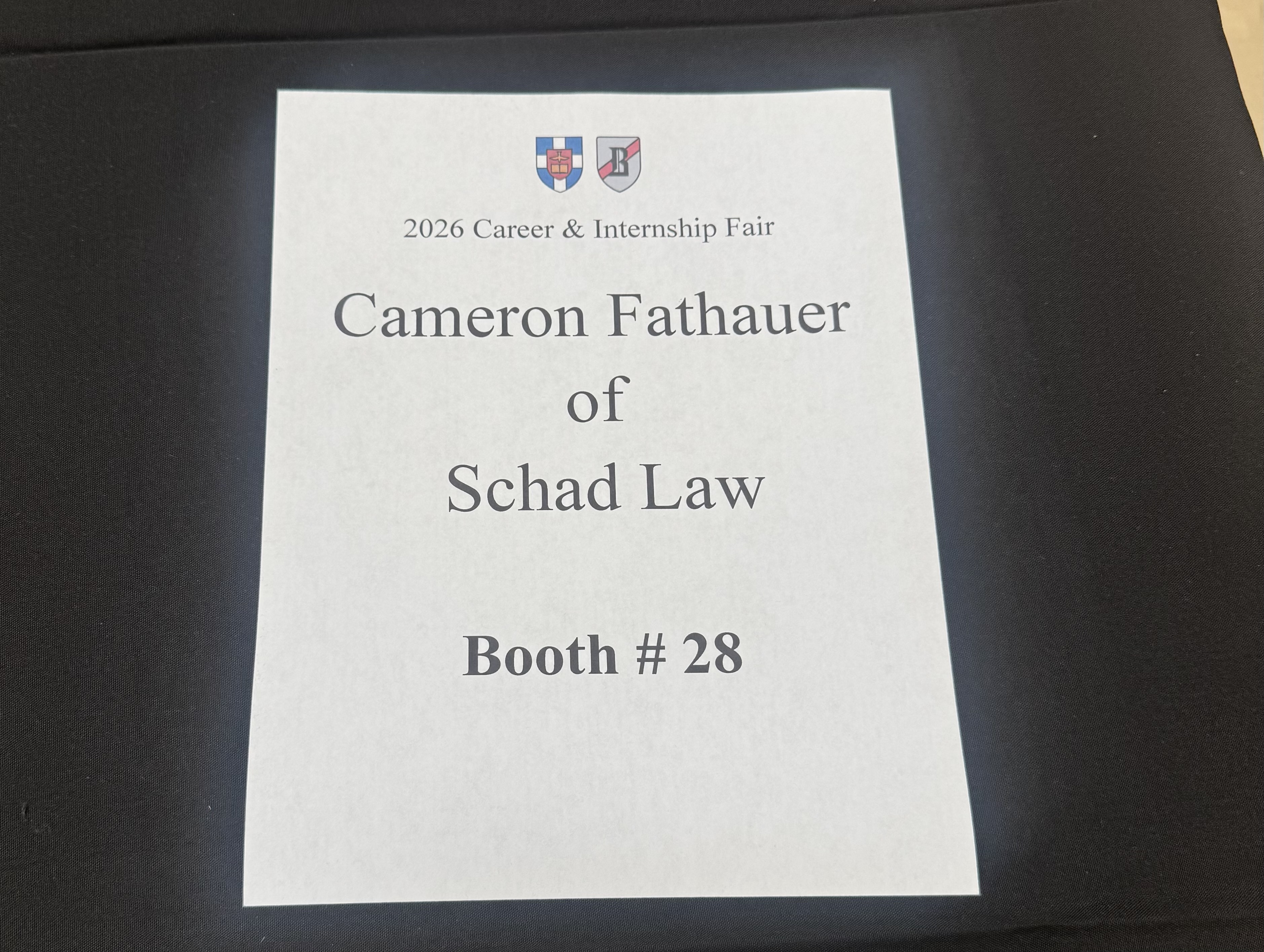
By 12:15, I was driving to Southern for the Boyce College Career Fair, where I stood in a three-piece suit behind a sign that read, “Cameron Fathauer of Schad Law.” I was stationed at Booth 28.
It took me a minute to notice how much of my life was sitting on that black tablecloth.

The 3D skull matches my own and reminds me of the impossible season the Lord got me through. But that season also gave me Matt Schad, the attorney who handled my injury case and eventually pointed me to the law. The law became my profession, and Saving the Subject grew out of the beautiful chaos that happened in between. Yesterday almost all of that life sat on one table as an invitation for students to learn the law by being in the room with me.
Ten years ago, I was on the other side of the table—a student in that same gymnasium with big dreams and goals, but not yet the relationships that would help make any of them possible.
Yesterday I came back to the table, this time with a J.D., ten years of marriage, four kids, and a law firm’s name beside my own, offering students an opportunity to see the profession from the inside. The gym didn’t change. Only my side of the table had.
The part of the career fair I keep replaying in my head happened five minutes before the doors even opened. I had left the gym headed to the restroom when I found Jacob, Jessi, and Abe at the front of the line. They said they were waiting to see me. What’s important is that these are not people who know me primarily as the attorney or author. They know the ridiculous, twenty-something version of me.
Jacob has eaten ramen with me at 1 a.m. and accompanied me on an 11 p.m. Meijer run because Chelsea wanted me to get some last-minute clothes for the girls. Abe and I sang “Eye of the Tiger” together during karaoke while I somehow held a handstand longer than I expected. Jessi is a dominant Spikeball player, and I am the fortunate one whenever I get to play on her team (otherwise I tend to lose).

There they were, first in line at a career fair, not because of what I had to offer them, but because of what I meant to them. That’s friendship. That’s the whole subject-over-object lesson right there, and it is richer and more generous than anything I could have put on the table.
Over ten students signed up for the legal apprenticeship, and at least four seemed serious about going to law school. I can still play frisbee and volleyball with these students—many of whom are not much younger than I am—work from their coffee shop, laugh with them in the hallway, and then put on a three-piece suit and stand behind a table representing an actual law firm.
If that proximity does anything for them, I hope it makes the profession feel more accessible and less like an abstract world belonging to somebody else. I hope I can give a few of them what I was blessed to have early on with Matt Schad: a relationship with someone already inside the profession, willing to make room for them.

Several students were surprised to learn that I am an attorney at all, which is funny considering how many legal matters I have handled while sitting on that campus. To most of them, I am just Cameron. I find that incredibly life-giving.
After the event, I sat in a study area with two students, Mack and Ashley. Mack knew that I had triplets—and she is a triplet herself—but otherwise we were mostly still getting to know one another. That has been one of my favorite things about this campus: nobody needs a biography before there can be a conversation. We just made room for one another at the table. We laughed about how to pronounce my last name—Fathauer, “Fad-hour,” “Fat-hour”—and Ashley kept repeating it like my last name had no business being that entertaining to say.
Many of these students have been teaching me a lesson all semester: that the person precedes any prestige. It’s the subject before the object, and this campus does it naturally (some might even say supernaturally).
I used to assume (and still struggle with the same) that my connections and relationships would arrive through achievement—that if I accomplished enough, wrote enough, or succeeded enough, perhaps the distance between me and everybody else would finally close. But that’s almost exactly backward.
Objective accomplishment can actually create subjective distance between people. Titles can create hierarchy. Status can create separation. Résumés tell us what somebody has done while sometimes obscuring who is standing in front of us.

But the qualities that actually make us human—love, kindness, presence, attention, genuine engagement—move in the opposite direction. They close the distance between people, and sometimes they change people in the process. I gave the campus something professional yesterday, and the campus gave me people.
So I write this for them. You were not being polite to a visiting alumnus. You were meeting a person instead of a performance, which is what I have spent years arguing people owe one another. And you did it without trying, which says something beautiful about your own hearts and character.
The last decade has held so much loss and victory. There have been courtrooms and keynotes, books and cases, hospitals and headlines. But the moments when I feel most alive are rarely those moments. They are sitting around a table with friends, the unexpected encounters in hallways and common spaces, and the ordinary conversations that somehow become the memorable parts of the day. It’s making somebody laugh hard enough to slap their knee; remembering somebody’s name after hearing it once; listening to someone’s lengthy story about how they lost their first pair of Crocs to a mud swamp; talking about my wife and kids; and reflecting on the God who lives above all of it.
Someday this season will end.
When it does, I hope the evidence that I was here is not a plaque, or a title, or even the book. I hope it is something smaller and better: a few friendships, a few shared stories, and the kind of ordinary memories that make an empty seat feel different.
Until then, please save one for me.
Leave a Reply