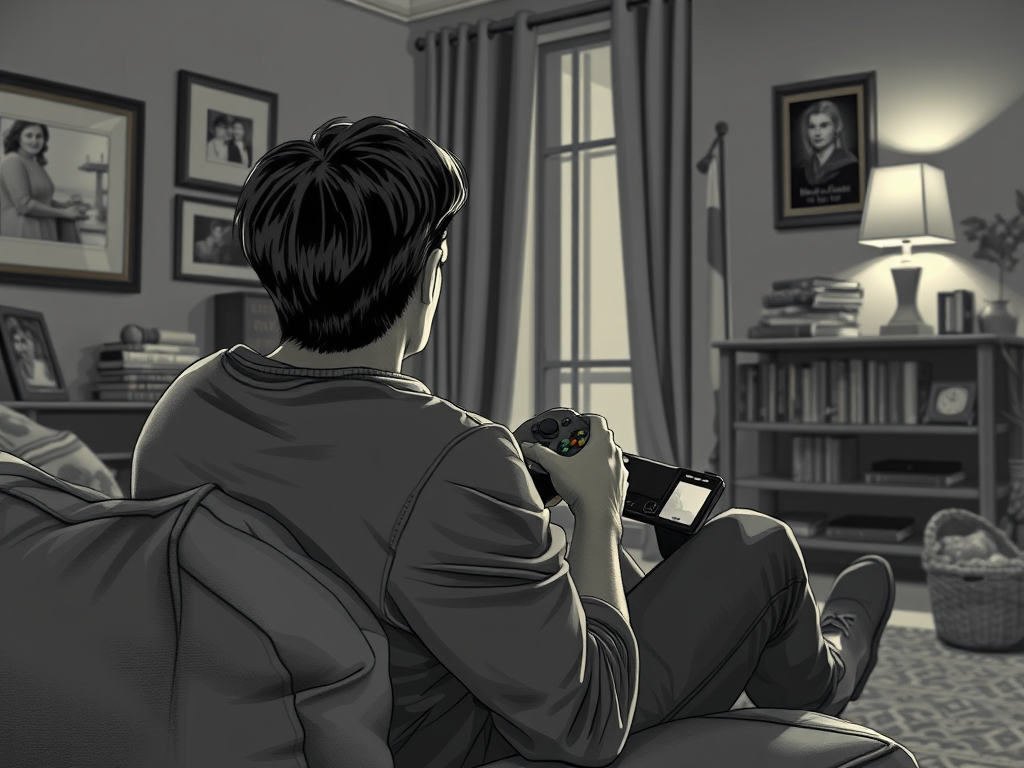
It wasn’t something I did all the time growing up—just enough to feel it mattered. A couple hours here or there with friends after school, the familiar sounds of Call of Duty: Black Ops humming through a TV that didn’t yet stream. I was never a “gamer.” But back then, sitting in front of an Xbox wasn’t about escape. It was about presence. Focus. Movement. A brief and strange kind of freedom.
Then everything stopped.
After the accident—after the coma, the skull fracture, the rewiring of my entire interior world—there was no space for play. Life became survival, then therapy, then relentless meaning-making. I learned how to walk again, how to speak again, how to remember the name of the woman waiting for me at Panera to plan our wedding. I became a lawyer. A father. A husband. A writer. A survivor. But the part of me that used to sit down and play a game just to play—that part went quiet.
For nearly a decade, I forgot what it felt like to be absorbed in something without needing it to mean anything.
Recently, I found myself back on the Xbox. No big announcement. No strategy. Just a quiet night, a familiar hum, and a decision to pick up the controller again.
And something strange happened: it felt natural. Like my hands remembered. Like part of my brain had been waiting, silently, to be invited back into the room.
Initially, I was skeptical about revisiting gaming. There was a part of me that feared it might be a step backward, a distraction from the ‘serious’ work of recovery and professional growth. But as I held the controller that night, I realized that healing isn’t just about moving forward—it’s also about reclaiming and embracing all parts of oneself, including those that find happiness in seemingly trivial pursuits.
Most people wouldn’t call Black Ops “therapeutic.” But for me, it’s become just that. Not in some clinical sense, but in the deeper way of what therapy at its best really does; it gives you back something you lost. It gives a sense of self again.
The irony is, for the last ten years, I’ve lived in the deep end of thought: writing about AI, trauma, the imago Dei, and what it means to be human. My brain has lived in the front of the house—executive function, abstract reasoning, theological reflection, language, ethics. Sacred spaces, to be sure, but also miraculous ones given what the doctor’s kept telling me about my type of head injury.
But playing again, jumping into those fast-paced, twitch-response worlds, I felt another part of my mind come “online.” Visual processing. Spatial instinct. Muscle memory. Not just thinking—reacting. Not just making meaning—moving through it.
For so long, I’ve lived in a world where the weight of being alive is what makes me feel human. And that’s still true. But there’s something about happiness—about flow, about embodiment—that reminds you: you’re not just a subject who suffers. You’re a subject who moves. Who plays. Who laughs. Who locks in and forgets, for a moment, that the world has ever broken you.
And maybe that’s what makes this so quietly powerful. Not that I’m gaming again, but that I’m letting myself be small again. Unscheduled. Unstructured. Not useful in any measurable way. And yet deeply restorative.
This isn’t regression. It’s return. Not to who I was before the accident, but to a part of me that the trauma buried under “shoulds” and “survival.” In picking up a controller again, I picked up something else: a little piece of my humanity I didn’t realize was still waiting for me.
In a life filled with deep thought and serious endeavors, it’s crucial to also make space for lightness and play. These moments of unscheduled joy are not just leisure; they’re an essential part of our humanity. They remind us that we are not just beings who endure but also beings who can delight in the simple act of living.
So yeah—I’m back on Xbox (a little bit). Not to escape my life, but to feel it in another way. To activate the brain that once felt like all it could do was grieve and grind. Now, it gets to respond. To move. To enjoy. And that, too, is a kind of healing. Maybe even a form of worship.
Leave a Reply